Silent and watchful, Anubis is one of Egypt’s most ancient and enduring gods — the divine protector of the dead and guide of souls through the afterlife. Depicted as a sleek black jackal or a man with a jackal’s head, Anubis embodies the sacred balance between mortality and immortality.
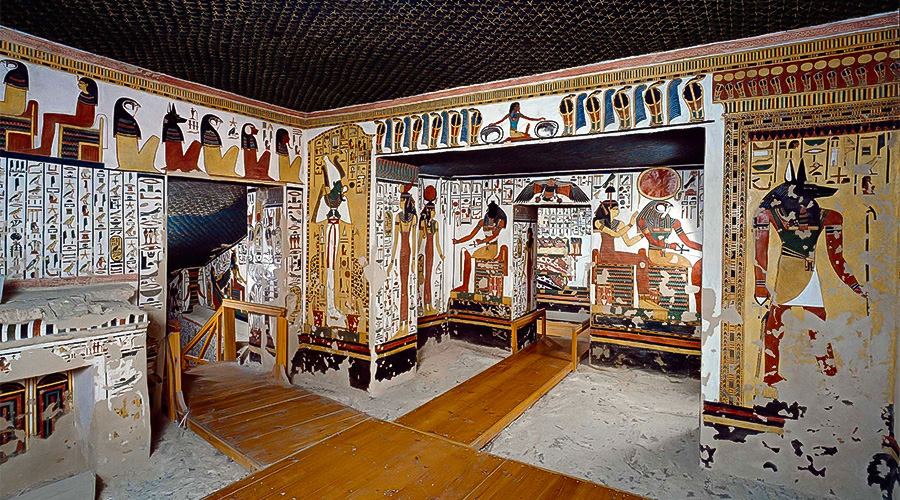
In ancient Egypt, he presided over mummification rituals and the Weighing of the Heart Ceremony, where each soul’s truth was measured against Ma’at’s feather of balance. His role was not to judge, but to guide — ensuring the spirit’s safe passage through the veils of transformation.
Today, travelers encounter his likeness throughout Egypt: in the tombs of the Valley of the Kings, in the temples of Saqqara, and in countless reliefs that mark the path between the living and the divine.
Myth & Symbolism
According to myth, Anubis is the son of Osiris and Nephthys, born from both shadow and light. When Osiris was slain, Anubis embalmed his father’s body and helped Isis restore him to life — thus becoming the first Embalmer and Guardian of the Dead.
His black color symbolizes regeneration and fertility — the same hue as the rich soil of the Nile that gives birth to life after the floods. The jackal, a creature often seen near ancient cemeteries, was seen as both watcher and protector — one who ensures that the soul finds its way home.
In every sense, Anubis represents transition, protection, and truth — the guardian of the gates that lead from illusion to eternity.
Spiritual Connection for Travelers
For spiritual seekers and modern pilgrims, Anubis offers a powerful energy of inner transformation and release. His presence is often felt in places of stillness — deep tombs, sacred chambers, or during quiet moments of reflection at Saqqara or Luxor’s necropolises.
He invites travelers to confront fear, grief, and endings — not as darkness, but as initiation. Anubis teaches that to walk through endings with awareness is to awaken the immortal self. For those who have experienced loss, change, or rebirth, visiting his sacred sites often feels like being guided through a doorway into peace.
To stand before his carvings is to remember that death, in every form — physical, emotional, or symbolic — is simply the soul’s way of transforming into new life.
Highlights of the Temples & Tombs
-
Saqqara Necropolis – Ancient site where Anubis was venerated as the guardian of tombs and embalming grounds.
-
Valley of the Kings – Tomb reliefs depicting Anubis overseeing the weighing of the heart and the soul’s rebirth.
-
Abydos Temple – Scenes of Anubis assisting in the resurrection of Osiris, representing eternal life.
-
Museums of Cairo and Luxor – Remarkable statues and golden masks showing Anubis as protector of royal mummies.
Conclusion
Anubis is not a god of endings, but of transformation. He reminds travelers that what we call death — whether of the body, the ego, or the past — is simply a return to truth. His quiet presence continues to guide souls, helping each one cross the thresholds of fear into the eternal light of awareness.
Ready to Explore?
Book your Saqqara and Memphis Day Tour with Luxor Booking Tours and follow the ancient path of Anubis — the guardian of the afterlife and keeper of the soul’s eternal flame.