While Luxor and its surroundings are filled with remarkable temples, there is one place that stands apart in both meaning and atmosphere—Abydos.
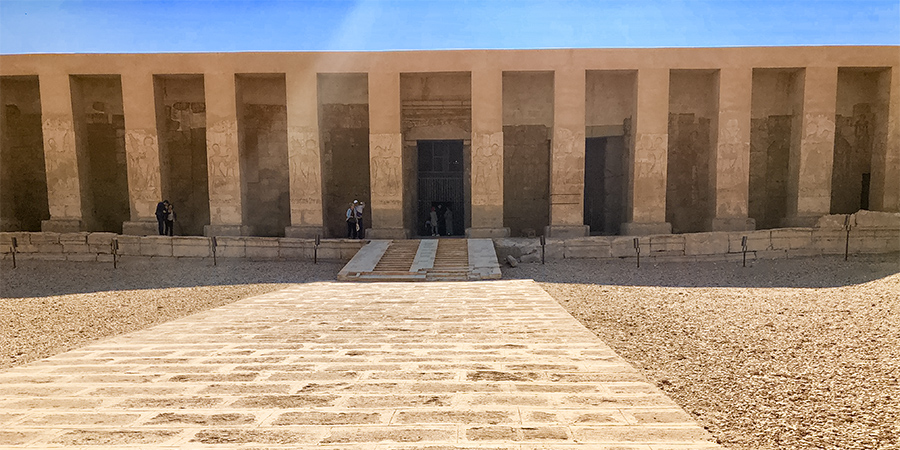
Located further north from Luxor than Dendera, Abydos is not part of the standard tourist route. Yet for many travelers who make the journey, it becomes one of the most memorable and impactful sites they visit.
This is not because it is the largest or most visually overwhelming, but because of what it represents.
Understanding Abydos requires looking beyond its structure and into its significance.
The Importance of Abydos in Ancient Egypt
Abydos was one of the most sacred places in ancient Egypt.
It was closely associated with Osiris, the deity connected to:
• The afterlife
• Renewal and rebirth
• The cycle of life and death
For ancient Egyptians, Abydos was not just a temple—it was a destination of deep meaning.
Many believed that being connected to Abydos, even symbolically, was important for the journey after death.
This alone sets it apart from most other sites.
A Temple Built Around Meaning, Not Just Power
The main temple at Abydos, built by Seti I, is known for its refined design and detailed reliefs.
Unlike larger complexes that emphasize scale, Abydos focuses on:
• Precision in carvings
• Clear narrative scenes
• Structured internal spaces
Every section of the temple has a purpose, and the layout feels intentional rather than overwhelming.
This creates a more focused and immersive experience.
The Atmosphere of the Temple
One of the first things visitors notice is the atmosphere.
Abydos often feels:
• Quieter
• Less crowded
• More contained
Because it is further from major tourist routes, it does not experience the same level of traffic as Luxor’s main sites.
This allows:
• More time to observe details
• Less pressure to move quickly
• A calmer overall experience
The environment naturally encourages slower movement.
The Osiris Connection and Symbolism
The spiritual importance of Abydos is deeply tied to Osiris.
The temple includes:
• Symbolic references to the afterlife
• Spaces connected to ancient rituals
• A layout that reflects transformation and continuity
Even without detailed knowledge, many visitors feel that the site has a different tone compared to other temples.
It feels more inward and reflective.
The Famous Abydos King List
One of the most important features of Abydos is the King List.
This carved sequence of rulers:
• Shows a historical lineage
• Reflects continuity and order
• Connects past rulers in a single narrative
While often viewed as a historical artifact, it also represents a deeper idea of connection through time.
This reinforces the theme of continuity present throughout the site.
Interior Experience vs Exterior Scale
Unlike open-air temples, Abydos draws attention inward.
Inside the temple:
• Lighting is softer
• Details are more visible
• Movement is slower
This creates a different rhythm compared to large open complexes.
Instead of being impressed by scale, visitors engage more with detail.
Distance and the Journey Itself
Reaching Abydos requires more effort than visiting standard Luxor sites.
This journey:
• Creates separation from busy areas
• Reduces crowd levels
• Prepares visitors for a different pace
By the time you arrive, the experience already feels distinct.
This contributes to the overall atmosphere.
Comparing Abydos to Other Temples
Understanding Abydos becomes clearer when compared to other sites.
Karnak:
• Large and complex
• High visitor flow
• Emphasis on scale
Dendera:
• Enclosed and preserved
• Strong visual detail
• More immersive structure
Abydos:
• Meaning-driven
• Calm and focused
• Less crowded and more reflective
Each has value, but Abydos stands out for its symbolic importance.
When to Visit Abydos
Because of the travel distance, planning your visit is important.
The best approach includes:
• Starting early from Luxor
• Allowing enough time at the site
• Avoiding combining too many stops in one day
A rushed visit reduces the impact of the experience.
Giving yourself time allows you to understand the space more fully.
Who Should Visit Abydos
Abydos is especially suitable for travelers who:
• Are interested in deeper meaning, not just visuals
• Prefer quieter and less crowded locations
• Want to explore beyond the main tourist path
It may not appeal as strongly to those looking for quick highlights.
Common Misconception
Some travelers expect Abydos to feel dramatically different in an obvious way.
In reality, the difference is more subtle.
It comes from:
• The atmosphere
• The symbolism
• The reduced pace
Understanding this helps you appreciate the experience more.
Final Thoughts
Abydos is one of the most meaningful sites in Egypt, not because of its size, but because of what it represents.
It offers a quieter, more focused experience that stands apart from the more visited temples of Luxor.
For travelers willing to go further and slow down, Abydos becomes more than just another stop—it becomes a highlight.
Related Experiences in Upper Egypt
• Private day trips from Luxor to Abydos
• Combined visits to Abydos and Dendera
• Custom itineraries focused on deeper exploration
Take the time to visit Abydos, and you may experience a different side of Egypt that many travelers never see.